
The Power of a Regulated Room
Why some of the most powerful nervous system work happens together.
We talk a lot about regulating ourselves.
Take the deep breath. Go for the walk. Put the phone down. Journal. Meditate. Get eight hours of sleep. Protect your peace.
All useful things.
But somewhere along the way, nervous system regulation became another thing we were expected to master alone.
The reality is that humans have always regulated in relationship. A calm voice. Someone sitting beside you. A room where you don't have to perform. The feeling of being around people who make your shoulders drop without you even realizing they were tense.
Sometimes your nervous system doesn't need another coping mechanism.
Sometimes it needs to experience what safety feels like in the presence of other people.
That’s part of what makes Somatic Experiencing® in a group setting so interesting.
Your Nervous System Is Paying Attention to the Room
You know the feeling.
You walk into one room and immediately tense up. You walk into another and something in you softens.
Nothing has been said yet.
Your body is simply gathering information.
Our nervous systems are constantly responding to what is happening around us — tone of voice, facial expressions, movement, proximity, connection, perceived threat. Often long before our conscious minds have decided how we feel about a situation, our bodies have already started responding.
For people living with anxiety, chronic stress or the effects of trauma, that internal alarm system can become especially sensitive.
You might know logically that you're safe while your body is telling a completely different story.
This is where Somatic Experiencing® shifts the conversation.
Rather than focusing only on the story of what happened, Somatic Experiencing® invites us to notice what is happening right now.
The tightness in your chest.
The urge to pull away.
The breath you've been holding.
The moment your hands begin to unclench.
The tiny shift that happens when your body realizes it doesn't have to brace quite so hard.
Regulation Isn't Always a Solo Practice
Wellness culture loves independence.
The morning routine. The solo meditation. The perfectly optimized nervous system.
But regulation has never been entirely individual.
We are affected by one another.
Think about the person whose presence instantly makes you feel calmer. The friend you call when everything feels like too much. The difference between crying alone and crying while someone you trust sits beside you.
That's co-regulation.
Our bodies take cues from the people around us. A sense of steadiness, connection and presence can help create conditions where the nervous system begins to soften.
And in a therapeutic group setting, that shared experience can become part of the work.
You aren't just learning how to regulate in isolation.
You're practicing what it feels like to remain connected to yourself while other people are in the room.
Group Therapy Without the Pressure to Perform
The words group therapy can bring up a very specific image.
A circle of chairs. Everyone staring at you. Someone saying, So, who wants to share?
Somatic group work can look very different.
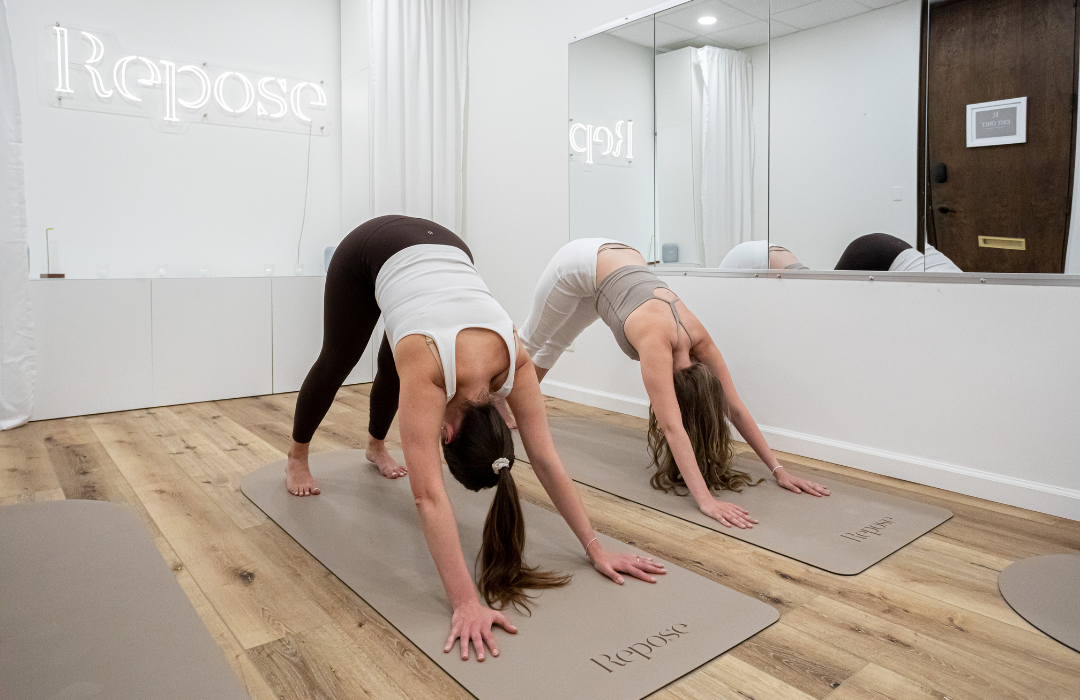
At Repose, Somatic Experiencing® group sessions are therapist-led spaces that use body awareness, gentle movement, breath and nervous system tracking to help participants become more aware of what they're experiencing internally.
There isn't pressure to arrive with a perfectly articulated problem.
You don't have to tell your entire story.
You don't have to be the most vulnerable person in the room.
The work can be much quieter than that.
Maybe you notice your feet on the floor.
Maybe you recognize the exact moment your body starts to tense.
Maybe you experiment with allowing a sensation to exist without immediately trying to make it disappear.
Maybe you realize that being around other people doesn't automatically mean you have to shrink, please, perform or disappear.
Small moments can carry a surprising amount of information.
The Room Becomes Part of the Work
There is something uniquely powerful about noticing your body while surrounded by other people doing the same.
Someone takes a deeper breath.
Someone shifts their posture.
The room gets quieter.
You realize you don't have to fill the silence.
You begin noticing what happens inside you when you're witnessed without being judged, analyzed or asked to explain yourself.
For people whose nervous systems have learned to associate relationships with unpredictability, conflict or stress, these experiences can matter.
Because healing isn't only about feeling safe when you're alone.
It's also about expanding your capacity to feel like yourself while you're with other people.
Less "Fix Yourself." More "Notice Yourself."
Somatic Experiencing® isn't about forcing the nervous system into calm.
And it isn't about pretending that a few deep breaths can erase difficult experiences.
The work is more nuanced.
Somatic Experiencing® helps people build awareness of sensations, impulses and nervous system responses at a pace that feels manageable. Instead of diving directly into overwhelm, the practice works gradually — noticing moments of activation while also identifying sensations of support, ease and stability.
Over time, those small experiences can help expand our capacity to be with difficult emotions and sensations without becoming completely consumed by them.
The goal isn't to become a person who never gets anxious, overwhelmed or activated.
It's to develop more flexibility in how you move through those states.
To recognize what's happening.
To stay connected to yourself.
And to know that you can find your way back.
Healing Can Be Witnessed Without Being Explained
There is a particular kind of relief that comes from realizing you don't have to explain everything.
You can simply be in the room.
You can notice.
You can participate as much as feels right.
And you can discover that other people are navigating their own internal worlds beside you.
There is no competition over who has experienced the most.
No requirement to turn pain into a perfectly packaged story.
Sometimes the most meaningful thing about a group is simply the recognition:
I'm not the only person whose body does this.
That realization alone can soften something.
Somatic Experiencing® Group Sessions at Repose
At Repose, Somatic Experiencing® group sessions offer a therapist-led space to explore nervous system regulation, body awareness and connection alongside others.
Through guided awareness, gentle movement, breath and somatic practices, participants are invited to slow down and become curious about what's happening beneath the surface.
These sessions can be especially supportive for people navigating anxiety, chronic stress, trauma responses or simply feeling disconnected from their bodies.
You don't need previous experience with Somatic Experiencing®.
You don't need to know exactly what you want to work on.
And you certainly don't need to arrive already regulated.
That's kind of the point.
Maybe We Were Never Supposed to Do All of This Alone
There is value in learning how to support yourself.
To recognize your needs. To understand your patterns. To find practices that help you return to yourself.
But self-regulation was never meant to mean complete self-sufficiency.
Sometimes healing looks like learning to sit with yourself.
Sometimes it looks like discovering that you can sit with other people, too.
No performance.
No fixing.
No need to have the right words.
Just a room full of nervous systems slowly discovering that they don't have to be on guard all the time.
And sometimes, the room itself becomes part of the medicine.
Explore Somatic Experiencing® group sessions at Repose and find a space to begin.
